Many patients, both adults and children, arrive at an eye examination without knowing what to expect. This is entirely understandable. Unlike a visit to the GP, an eye examination uses specialised instruments and follows a sequence that most people have not encountered before. Knowing what is involved can make the appointment more productive and considerably less daunting.
This post walks through what typically happens at a comprehensive eye examination in Singapore. The steps are broadly similar across most optometry practices, though the exact tests included may vary depending on the reason for the appointment and the clinical picture.
How long does an eye examination take?
A standard adult eye examination takes approximately 30 to 45minutes. A children's myopia assessment, which includes additional measurements such as axial length, typically takes 45 to 60 minutes. For a first-ever visit, allow a little extra time at the start for a brief patient history.
What does the appointment begin with?
The optometrist will start by asking a few questions. These cover your current vision concerns, your occupation and daily visual demands, any spectacles or contact lenses you are currently wearing, your general health, and any family history of eye conditions.
Be as specific as possible about what you have noticed. If you are struggling to read a screen after a few hours, if something looks blurry at a particular distance, or if you have noticed any recent changes since your last examination, say so. This information helps the optometrist focus the assessment on what matters most to you.
Bring any spectacles or contact lenses you currently use, including pairs you have stopped wearing because they no longer feel right. These give the optometrist a baseline and help identify how your vision may have changed.
What is a refraction test and does it hurt?
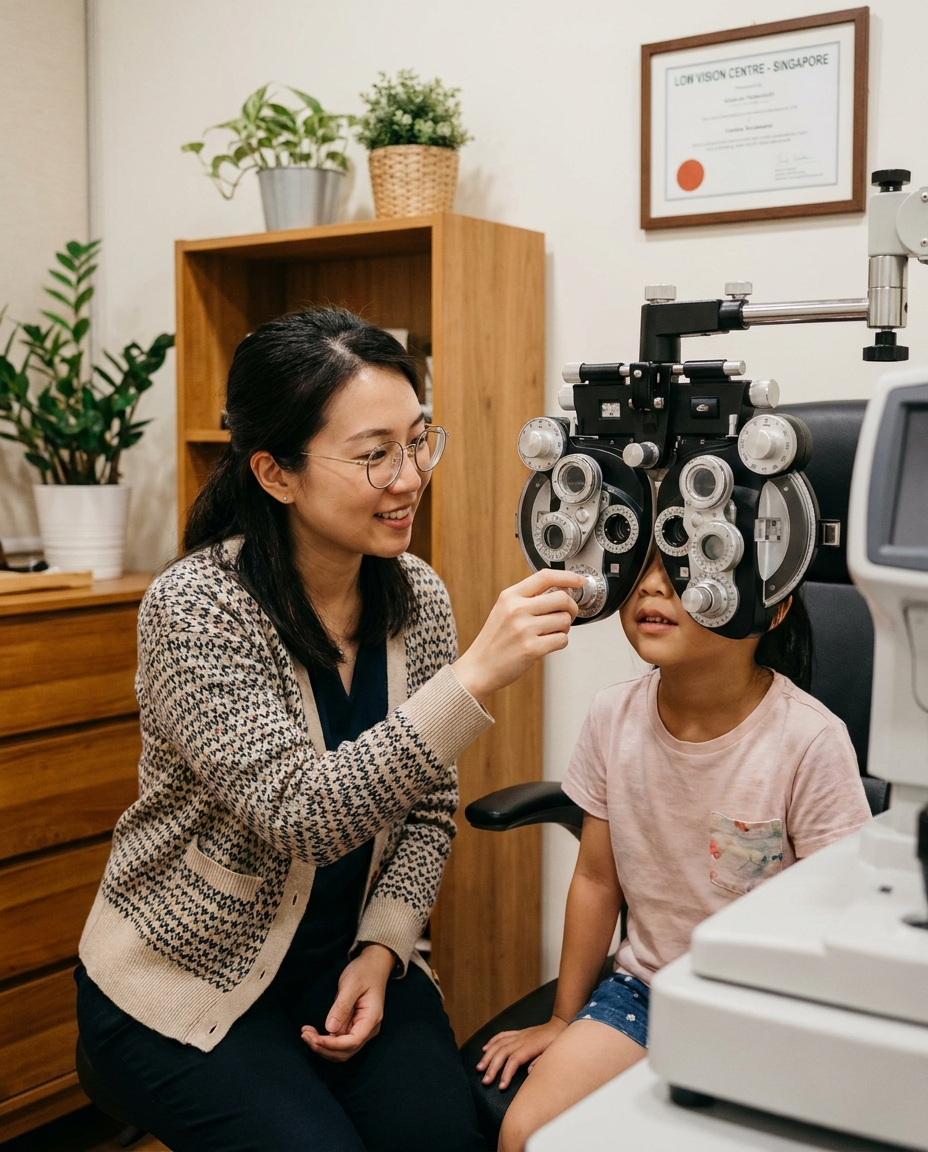
The refraction is the central part of the examination. This is the process by which the optometrist determines your spectacle prescription.
The optometrist will ask you to look at a chart or image at a set distance and compare pairs of lenses: is the first or the second clearer? Is this one better, or about the same?
There is no correct answer. You are simply describing what you see. The optometrist uses your responses to narrow down the combination of lenses that gives you the clearest, most comfortable vision for both distance and near. The process takes around 10 to 15 minutes.
The refraction is entirely non-invasive. Nothing touches the eye. Children as young as five or six can participate in a basic refraction, and our experienced optometrists are accustomed to working with younger patients who may find the process unfamiliar.
What other checks are included in a comprehensive eye examination?
A comprehensive examination assesses two areas: visual function and eye health. The refraction covers visual function. Several additional tests cover eye health.

Intraocular pressure check
This measures the fluid pressure inside the eye. Elevated pressure can be associated with glaucoma, a condition in which the optic nerve is progressively damaged. The test is done using either a brief puff of air directed at the surface of the eye, which many patients find startling but which is not painful, or a gentle contact measurement after an an aesthetic drop has been applied.
Cover test and eye movement assessment
This checks that both eyes are working together as a coordinated pair. The optometrist will observe how your eyes move and hold fixation on a target as it moves in different directions. This is particularly important for children, in whom certain eye misalignment conditions may not be immediately obvious to parents.
Slit lamp examination
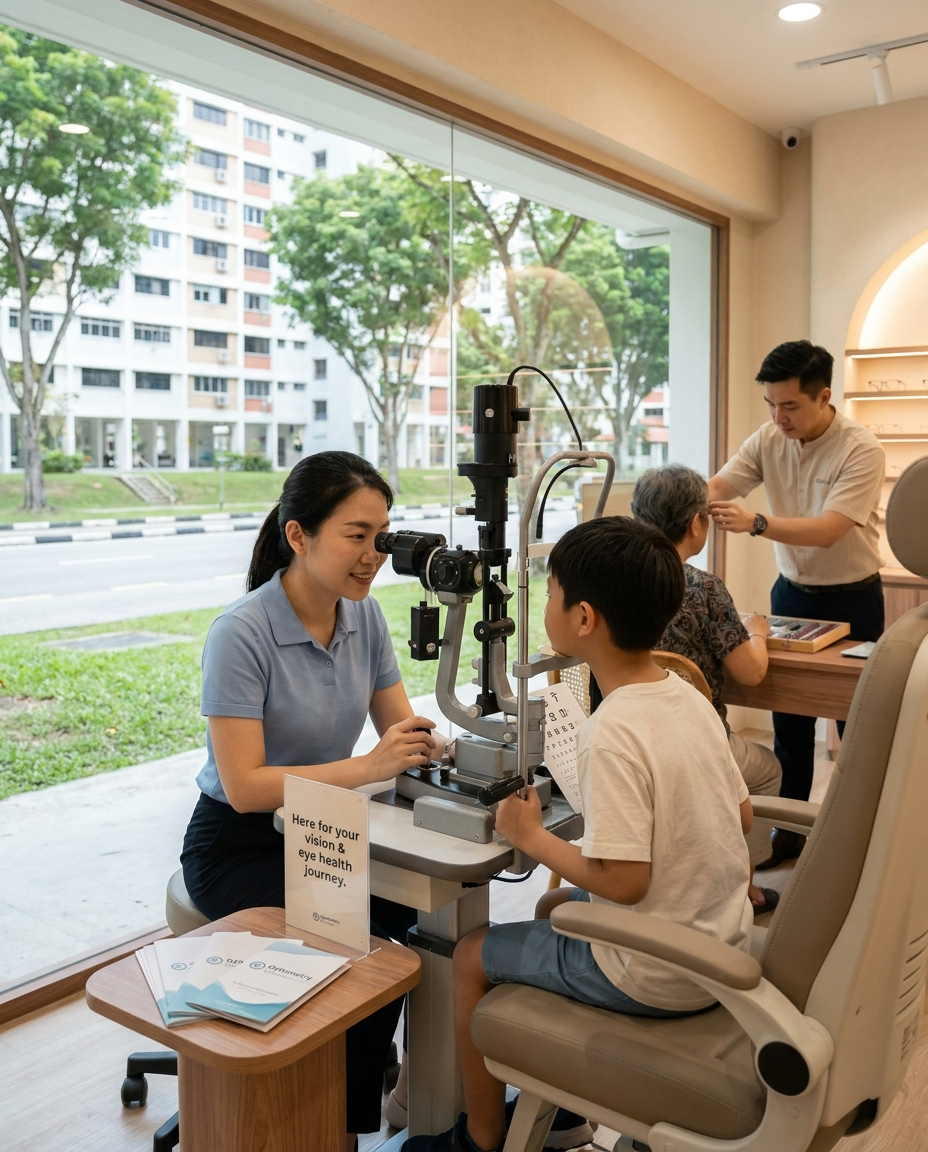
The slit lamp is a binocular microscope that allows the optometrist to examine the external structures of the eye under magnification. This checks the health of the cornea, the lens, the conjunctiva, and the front of the eye. Many conditions affecting the surface of the eye, including dryness, early cataract, and corneal changes, are identified at this stage.
Fundus examination
The fundus is the interior surface of the back of the eye, including the retina, the optic nerve head, and the blood vessels. The optometrist will examine this either through a dilated pupil or, in many modern practices, using digital retinal imaging, which photographs the retina without the need for dilation in most cases. This part of the examination identifies conditions including diabetic retinopathy, early signs of macular degeneration, and retinal changes associated with high myopia.
Axial length measurement (children's myopia assessment)
If your child is attending a myopia assessment rather than a standard eye test, axial length measurement is included. This measures the physical length of the eyeball from front to back using a low-powered light beam. It is non-contact and takes only a few seconds. Axial length is the primary clinical marker of myopia progression over time.
Will my eyes need to be dilated?
Not at every examination. Dilating drops widen the pupil to give the optometrist a broader view of the retinal periphery. They are used when a more thorough examination of the retina is indicated, or in certain children's assessments where a cycloplegic refraction is needed to relax the focusing muscles and produce the most accurate prescription measurement.
If your eyes are dilated, your near vision will be blurred for approximately two to four hours afterwards and you will be more sensitive to bright light. You should not drive until the effect has fully worn off.
Your optometrist will discuss with you whether dilation is needed before applying the drops.
What happens at the end of the examination?
The optometrist will explain their findings. If a prescription is needed or has changed, they will explain what the numbers mean in practical terms: what it means for your distance vision, your near vision, or in the case of a child, what it means for myopia management.
If any eye health findings require follow-up, the optometrist will advise on next steps. This may include a referral to an ophthalmologist for conditions that require medical management, such as cataract, glaucoma, or retinal concerns.
You will not be pressured to make any purchase at the appointment. The examination and any optical decision, such as choosing new spectacles or starting a myopia management programme, are separate steps. You are welcome to take time to consider our optometrist's recommendations before proceeding.
How often should I have an eye examination?
For adults with no existing vision concerns, an examination every two years is a reasonable starting point. Adults over 40 are advised to consider annual checks, as age-related changes to near vision typically begin during this decade and are more straightforward to manage when caught early.
Children with diagnosed myopia should be reviewed at least once a year. Children on an active myopia management programme, such as orthokeratology, are typically reviewed every three to six months, depending on the clinical plan.
If you notice any sudden changes to your vision, such as new floaters, flashes of light, a shadow in your peripheral vision, or a sudden blurring in one eye, see an optometrist or ophthalmologist promptly rather than waiting for a scheduled appointment.
Frequently Asked Questions
Is an eye examination the same as an eye test?
In general use, the terms are used interchangeably. A comprehensive examination is more thorough than a basic vision screening or eye test and includes an assessment of eye health in addition to measuring the prescription.
Do I need to bring my existing glasses?
Yes. Bring any spectacles or contact lenses you are currently wearing so that the optometrist can compare your current correction with the new findings.
Can I bring my young child even if they have not complained about their eyes?
Yes. A first assessment at school-entry age, around six to seven years, is appropriate even in the absence of complaints. Early detection of myopia allows management to begin at a stage where it is most effective.
Will I receive my prescription at the appointment?
Yes. Your spectacle prescription is yours and you are entitled to a copy. Ask for it at the end of the appointment if it is not provided automatically.
Is there anything I should do to prepare for an eye examination?
No special preparation is needed. If you wear contact lenses, it is advisable to stop wearing them for a day or two before the appointment, as lenses can temporarily alter corneal shape and affect measurement accuracy. Check with the practice when booking.
Book an appointment for your child today.