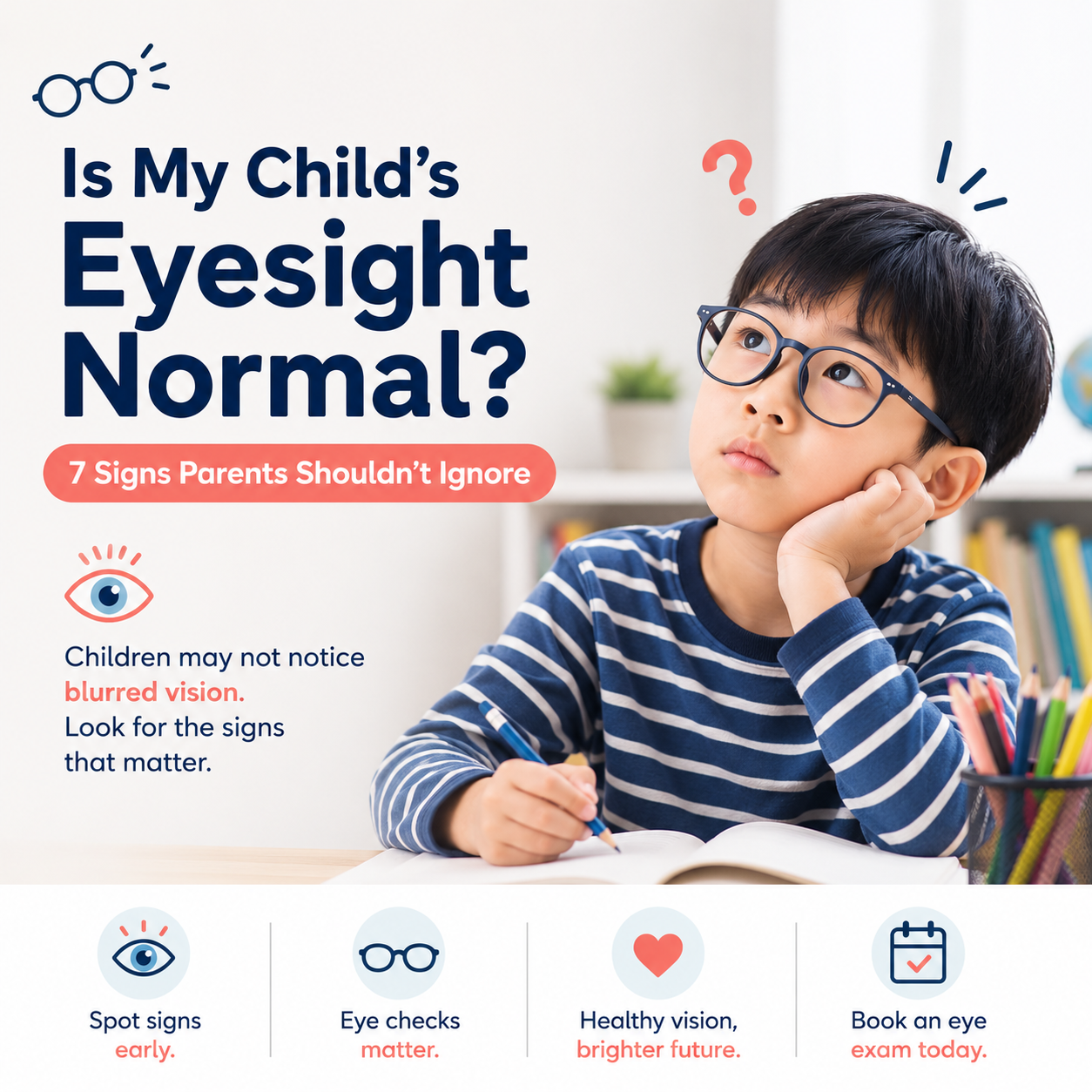
Many children don't realize their vision has changed because they assume everyone sees the world the same way they do. A child with blurred vision may continue to learn, play and read without ever mentioning that something isn't quite right.
Often, the first sign appears during a school vision screening or when parents notice their child squinting at the classroom whiteboard, sitting closer to the television or holding books unusually close.
If you've ever wondered what results like 6/6, 6/9 or 6/12 mean, this guide explains how to interpret your child's visual acuity and when it's time to arrange a comprehensive children's eye examination in Singapore.
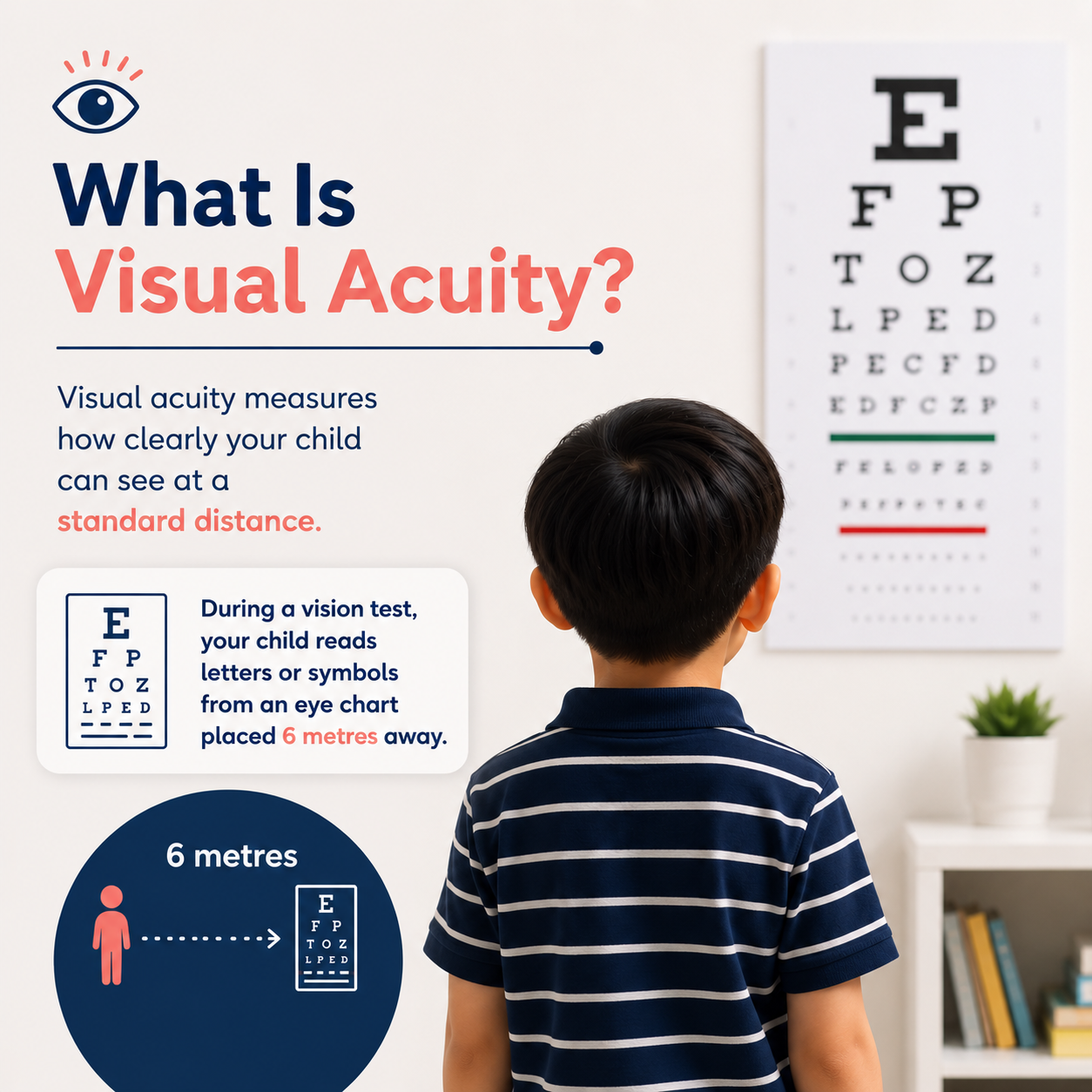
What Is Visual Acuity?
Visual acuity measures how clearly your child can see at astandard distance. During a vision test, your child reads letters or symbols from an eye chart placed 6 metres away.
The result is written as a fraction, such as:
- 6/6
- 6/9
- 6/12
- 6/18
The first number is always the testing distance (6 meters), while the second number indicates how well your child sees compared with someone who has standard vision.
Visual acuity is an important screening tool, but it is only one part of a comprehensive eye examination.
What Does 6/6 Vision Mean?
A result of 6/6 means your child can see at 6 metres what a person with normal vision is expected to see from the same distance.
This is generally considered normal distance vision.
However, having 6/6 vision does not always mean every aspectof eyesight is perfect. Some children may still experience problems with focusing, eye coordination or visual comfort that require further assessment.
What Does 6/9 Vision Mean?
A 6/9 result indicates mild reduction in distancevision.
Your child needs to stand 6 metres away to see whatsomeone with standard vision could see from 9 metres.
Possible causes include:
- Early myopia (short-sightedness)
- Astigmatism
- Eye fatigue
- Difficulty concentrating during the screening
- An outdated spectacle prescription
A 6/9 result does not automatically mean your child needs glasses, but it does warrant further evaluation if symptoms are present.
What Does 6/12 Vision Mean?
If your child records 6/12, it means they need to be 6 meters away to see what someone with standard vision can recognize from 12metres.
This represents a more noticeable reduction in vision and may affect daily activities such as:
- Seeing the classroom whiteboard
- Reading signs from a distance
- Recognising faces across a room
- Participating confidently in sports
A comprehensive eye examination can determine whether the cause is myopia, astigmatism or another vision problem.
Does My Child Need Glasses?
A school vision screening identifies children who may benefit from further assessment, but it does not diagnose the cause of reduced vision.
Some children with a 6/9 or even 6/12 result may require glasses, while others may simply need additional testing to assess their visual system more thoroughly.
A comprehensive eye examination evaluates:
- Visual acuity
- Spectacle prescription
- Eye coordination
- Focusing ability
- Eye health
- Binocular vision
7 Signs Parents Shouldn't Ignore
Even if your child has not complained about their eyesight,these signs may indicate that their vision should be checked.
1. Squinting to See Distant Objects
Frequent squinting can be an early sign of blurred distance vision.
2. Sitting Too Close to the Television
Children who consistently move closer to the TV may be compensating for difficulty seeing clearly from a distance.
3. Holding Books or Digital Devices Very Close
Reading or using tablets at an unusually close distance maysuggest a refractive error such as myopia.
4. Complaining of Frequent Headaches
Headaches after reading or schoolwork can sometimes beassociated with uncorrected vision problems.
5. Rubbing the Eyes Often
Persistent eye rubbing may be related to visual fatigue,allergies or eye irritation.
6. Difficulty Seeing the Classroom Whiteboard
If your child struggles to copy notes or says the boardlooks blurry, an eye examination is recommended.
7. Losing Interest in Reading or Schoolwork
Children with undetected vision problems may avoidactivities that require sustained visual effort.
Why School Vision Screening Is Only the First Step
School vision screening is valuable because it helpsidentify children who may require further assessment.
However, it cannot assess:
- Eye health
- Depth perception
- Eye coordination
- Focusing ability
- The exact spectacle prescription
- The cause of reduced vision
A comprehensive children's eye examination provides a morecomplete understanding of how your child's eyes work together and whethertreatment is needed.
When Should Your Child Have an Eye Examination?
Consider booking a children's eye examination if your child:
- Receives a 6/9, 6/12 or poorer school vision screening result
- Squints or complains of blurred vision
- Frequently experiences headaches or eye strain
- Has a family history of myopia
- Shows changes in school performance related to vision
- Has never had a comprehensive eye examination
If your child has difficulty seeing the whiteboard, has received an unexpected school vision screening result or you simply want reassurance that their eyesight is developing normally, a comprehensive eye examination can provide clear answers.
Book a Children's Eye Examination in Singapore
At People's Optics, our optometrists provide comprehensive children's eye examinations to assess visual acuity, prescription, eye coordination and overall eye health.