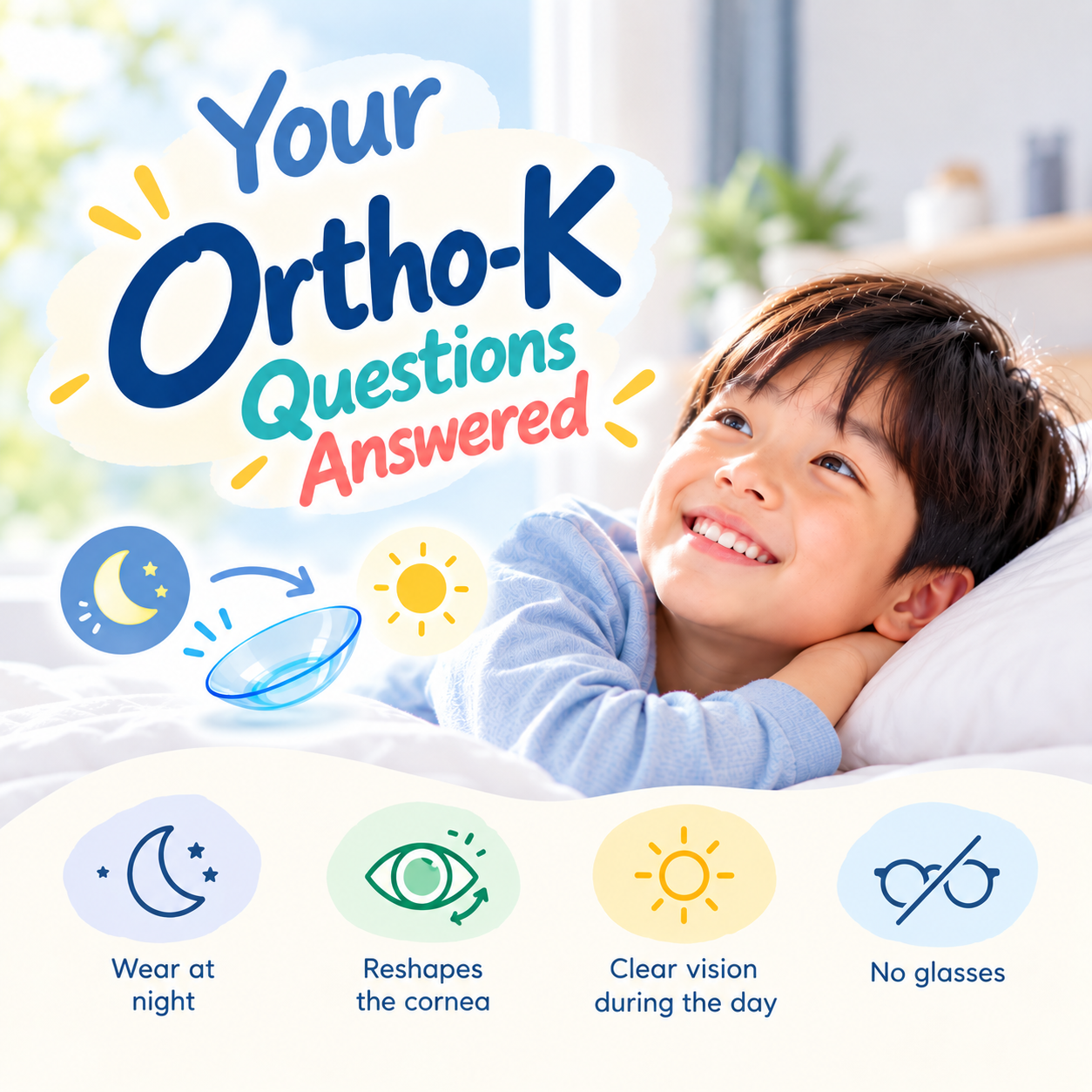
If you have a child with myopia, you may have heard about Ortho-K lenses as one of the options for managing short-sightedness.
But how does Ortho-K actually work? Is it safe to wear contact lenses while sleeping? At what age can a child start? And can Ortho-K really help with myopia control?
We asked Jerome, an optometrist at People’s Optics, to answer some of the most common questions parents and patients in Singapore have about Ortho-K.
Q: What Is Ortho-K?
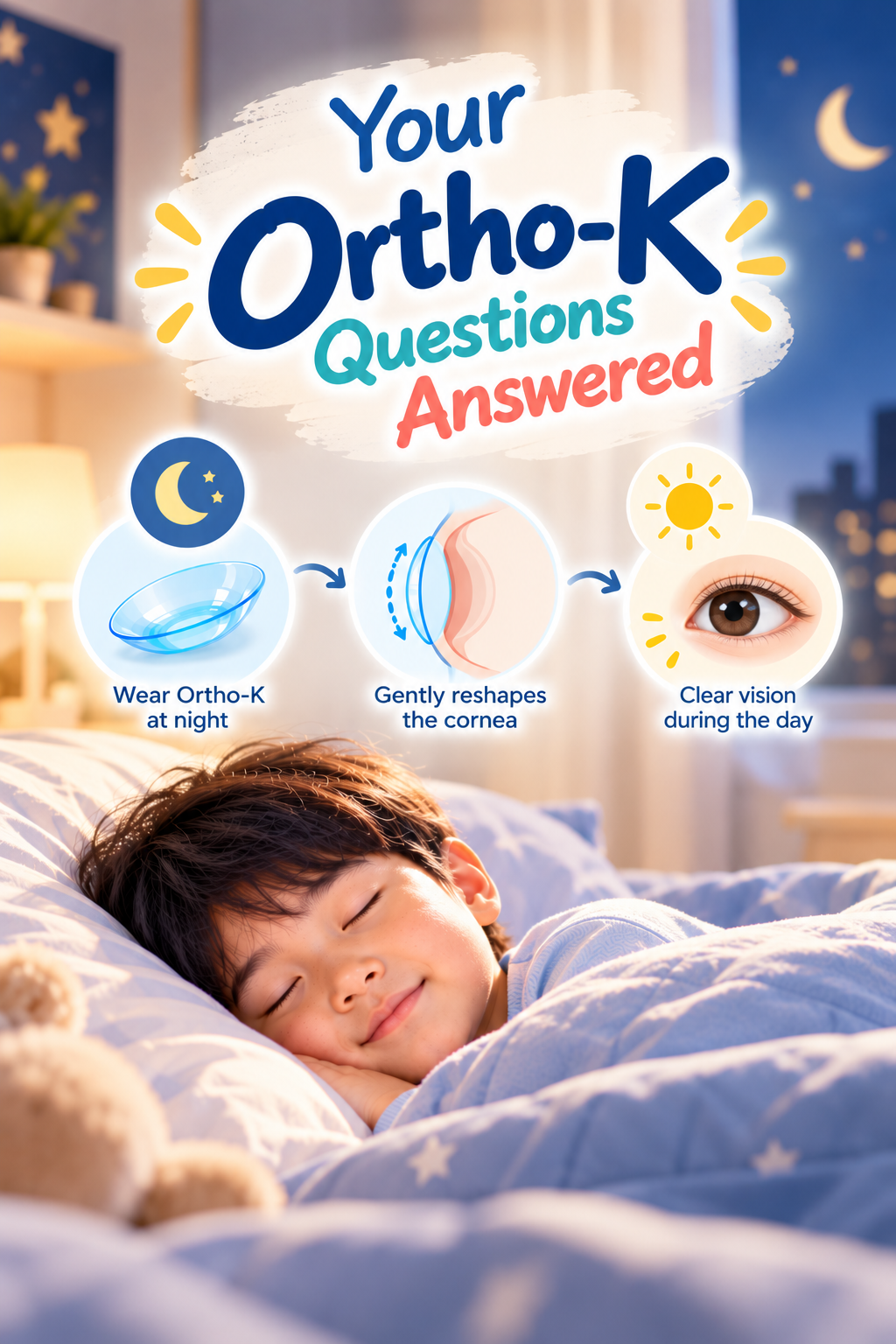
Jerome: Ortho-K, short for orthokeratology, uses specially designed rigid contact lenses that are worn overnight while you sleep.
The lenses gently and temporarily reshape the cornea, the clear front surface of the eye, while you sleep. After removing the lenses in the morning, many suitable wearers can see clearly during the day without needing spectacles or daytime contact lenses.
The effect is temporary, so the lenses generally need to beworn regularly at night to maintain the vision correction.
Q: How Does Ortho-K Work?
Jerome: Ortho-K lenses are individually fitted according to the shape of the eye and the person's prescription.
While the lenses are worn overnight, they create controlled changes in the corneal surface. This alters how light focuses inside the eye, allowing clearer distance vision after the lenses are removed in the morning.
Unlike LASIK or other refractive surgery, Ortho-K does not permanently change the cornea. If lens wear is discontinued, the cornea gradually returns towards its previous shape.
Q: Can Ortho-K Help Control Myopia in Children?
Jerome: This is one of the main reasons parents ask us about Ortho-K.
Myopia often begins during childhood and can continue progressing as a child grows. Research has found that orthokeratology can slow axial eye growth in many myopic children, which is why it is used as one option for myopia management.
However, Ortho-K does not permanently cure or reverse myopia. The goal of myopia control is to reduce the rate of progression overtime.
The most appropriate strategy depends on factors such as the child's prescription, eye health, corneal shape, lifestyle and previous rate of myopia progression.
Q: What Age Can a Child Start Ortho-K?
Jerome: There isn't one specific age that is suitable for every child.
Rather than looking at age alone, we consider whether the child is able to follow instructions, maintain good hygiene and handle the responsibilities involved in wearing contact lenses.
We also assess the child's myopia level, corneal shape, eye health and myopia progression before recommending Ortho-K.
For younger children, parental involvement is especially important because the lenses need to be cleaned, handled and worn correctly every day.
Q: Is Ortho-K Safe?
Jerome: Ortho-K can be a suitable option when lenses are professionally fitted, properly cared for and regularly monitored.
However, Ortho-K is still contact lens wear, and because the lenses are worn overnight, good hygiene is particularly important. Improper lens cleaning, exposure to tap water, poor hand hygiene or failure to attend follow-up appointments can increase the risk of complications, including eye infections.
That is why Ortho-K should not simply be purchased based on a prescription. Proper assessment, fitting and ongoing reviews are important parts of treatment.
Q: Does Ortho-K Work Immediately?
Jerome: Some people notice an improvement in their vision after the first few nights, but the time required to reach stable vision varies.
It depends partly on the starting prescription and how the eye responds to the lenses. During the initial fitting period, vision may fluctuate while the cornea adapts.
We normally schedule follow-up visits to check vision, lens positioning, corneal response and overall eye health.
Q: Who May Be Suitable for Ortho-K?
Jerome: Ortho-K may be considered for children and adults with suitable prescriptions and healthy eyes.
It can be particularly appealing to children who are active in sports and outdoor activities, as they may be able to go through much of their day without spectacles or daytime contact lenses.
For children with progressing myopia, the potential myopia-control benefit may also be an important consideration.
However, not everyone is suitable. A comprehensive assessment is necessary before deciding whether Ortho-K is an appropriateoption.
Q: What Happens During an Ortho-K Assessment?
At People’s Optics, an Ortho-K assessment may include checking your child's vision and prescription, corneal shape, eye health and suitability for overnight contact lens wear.
We will also discuss the child's myopia history, lifestyle and ability to manage the lenses responsibly.
If Ortho-K is suitable, the lenses are fitted specifically for the individual's eyes, followed by regular reviews to monitor vision, lens performance and eye health.
Thinking About Ortho-K for Your Child?
If your child's myopia is increasing, it may be worth discussing the different myopia control options available in Singapore, including whether Ortho-K is appropriate.
There is no single myopia-management approach that is right for every child. A professional eye examination can help determine which options are suitable based on your child's eyes, prescription and lifestyle.
Have an Ortho-K question for Jerome?
Visit People’s Optics at Yishun or Tampines, Singapore, for an Ortho-K and myopia management assessment. Our optometrists can assess your child's vision and discuss suitable options for managing myopia over time.